 EVERY ORDER SUPPORTS FAMILIES IN NEED



Updated 2 comments
Dental burs come in dozens of shapes, materials and shank lengths, and the names alone can be confusing. This guide covers the main types of burs in dentistry: dental bur names with pictures, what each one is used for, and how they are sorted by material, shank and shape. Use it as a quick reference the next time you need to work out which bur does what.
Jump to: bur names and pictures · by material · by shank · by shape · by procedure
Dental Burs Names and Pictures
Here are the burs a general practice meets most often, laid out side by side. The shape name is what most clinicians use in conversation; the number column shows how catalogues label the same bur.

| Bur name | Common number / ISO shape code | Main use | Shop |
|---|---|---|---|
| Round bur | ISO 001 · carbide ¼–8 | Caries removal, cavity opening, endodontic access | Round burs |
| Pear bur | 330, 245 · ISO 237 / 238 / 239 | Cavity preparation, trimming, finishing | Pear shaped burs |
| Inverted cone bur | ISO 010 · carbide 33½–39 | Undercuts, retention grooves, flattening cavity floors | Carbide burs |
| Cylinder bur | ISO 108–111 (flat end) · 138–142 (round end) | Shoulder and chamfer margins, axial walls, occlusal reduction | Cylinder burs |
| Straight fissure bur | 557 (cross cut) | Cavity walls, flat floors, outline form | Cross cut fissure burs |
| Tapered fissure bur | 169–171 · cross cut 1702 | Sectioning crowns, reducing crown height, cavity walls | Tapered fissure burs |
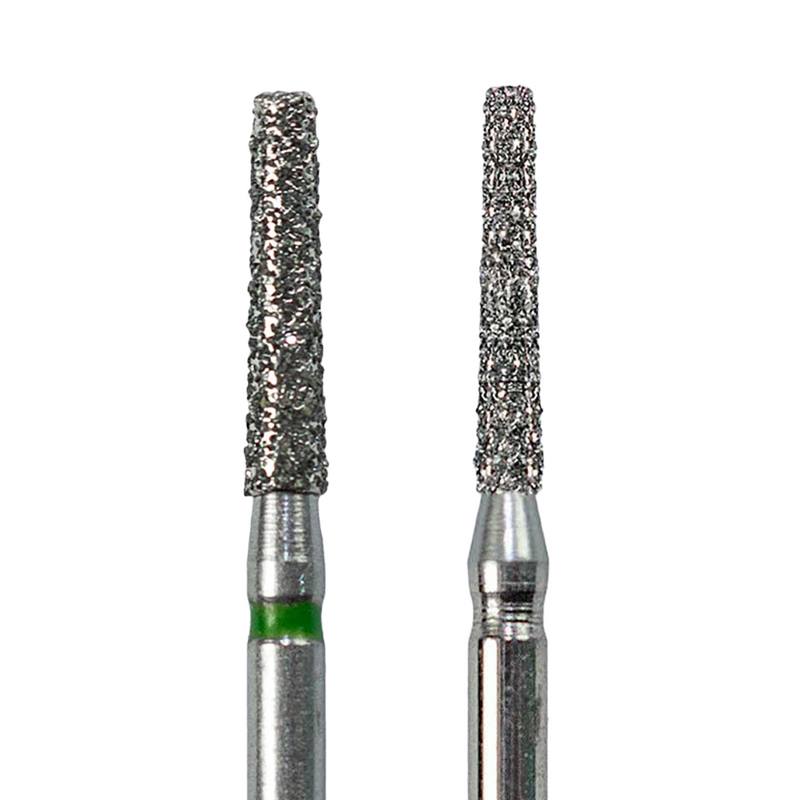
| Flat end taper | ISO 169–173 | Crown and bridge preparation, shoulder margins | Flat end taper burs |
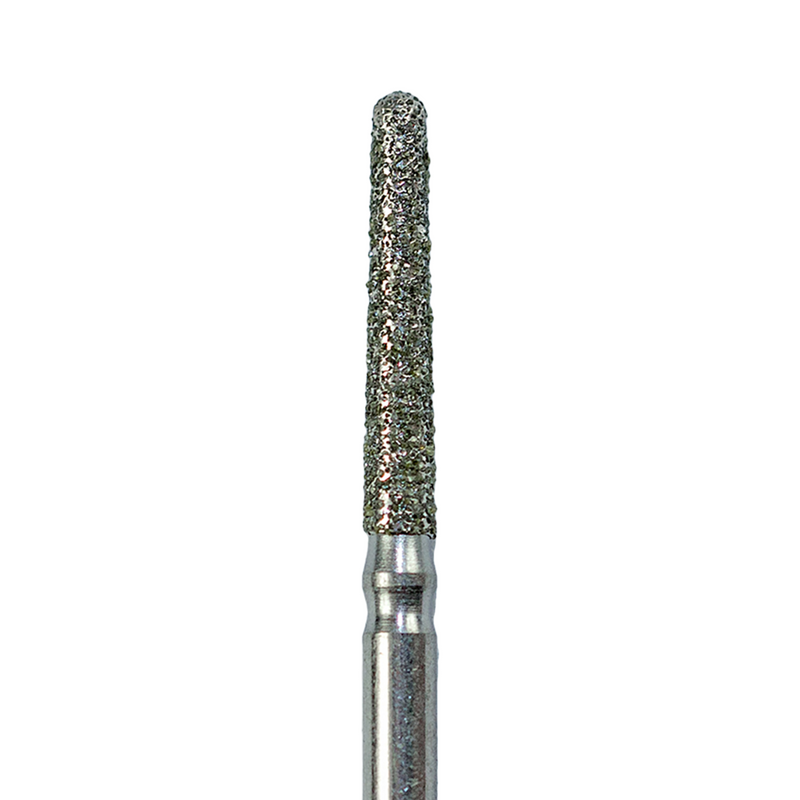
| Round end taper | ISO 196–199 | Crown and bridge preparation, chamfer margins | Round end taper burs |
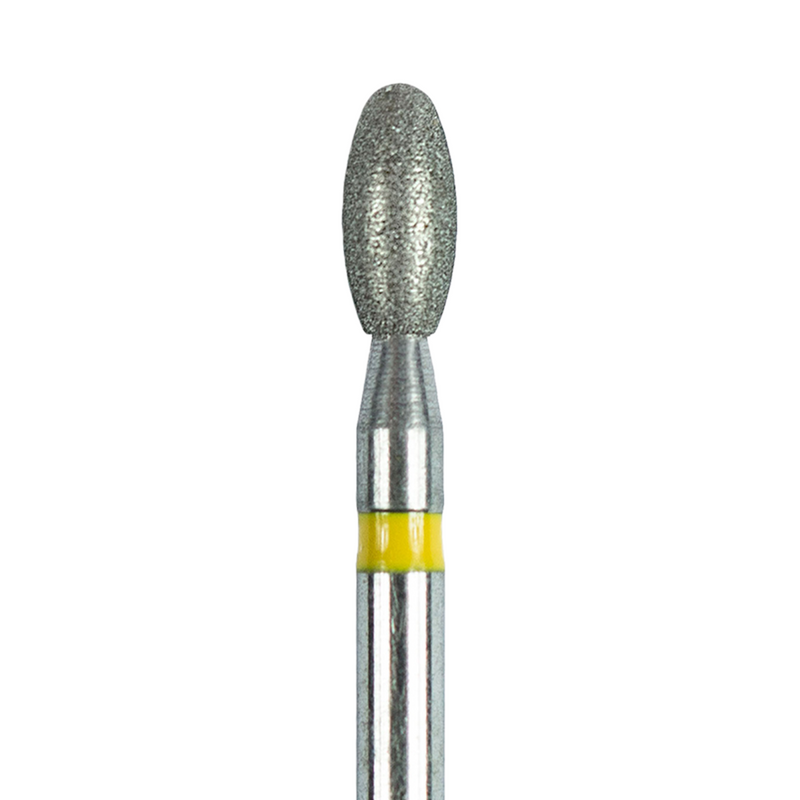
| Football / egg bur | ISO 257 (football) · 277 (egg) | Occlusal reduction, lingual reduction, finishing | Football burs |
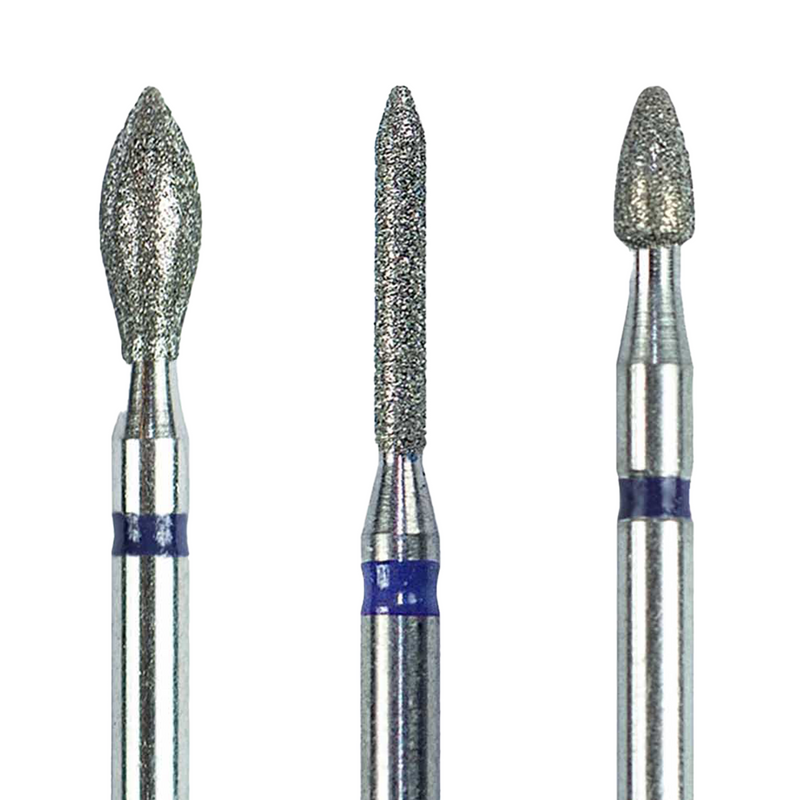
| Flame bur | ISO 247–250 | Contouring and finishing, interproximal and lingual areas | Flame burs |
| Torpedo bur | ISO 288–290 | Cavity preparation, contouring | Diamond burs |
| Needle bur | ISO 164–166 | Interproximal access, fine contouring | Needle burs |
| Wheel bur | ISO 041 / 042 | Lingual reduction, occlusal grooves | Wheel burs |
The three-digit ISO numbers shown here describe bur head shapes and are used across dental rotary instruments. Traditional numbers such as 330, 245 and 557 are also widely used, especially for carbide burs. To decode a full ISO number, read our dental burs guide to shapes, shanks and grits.
In the shop: Diamond burs · Carbide burs · Dental burs kits · All dental burs
Types of Burs by Material
The material decides how a bur removes tooth structure, and most practices keep more than one kind in the tray.
Diamond burs
Diamond burs are steel blanks coated with diamond grit. They remove material by abrasion, and the grit level sets how rough or smooth the surface is left: coarse grits reduce quickly, fine grits finish. They are the usual choice for enamel, crown and veneer preparation and ceramic adjustment. For the full comparison, see diamond vs carbide burs.


Carbide burs
Carbide burs have cutting blades made from tungsten carbide. They are used for cavity preparation, caries removal, finishing composite and amalgam, trimming acrylic, and cutting metal and bone. Generally, fewer blades give more aggressive cutting, while higher blade counts are used for finishing.


Gold diamond burs
Gold burs are premium diamond burs. In Eagle's gold range the highly homogeneous spread of the diamond is designed to give smoother work with less vibration, a lower operating temperature, higher durability and a better surface finish. See gold flame burs and needle shaped gold burs.


Ceramic burs
Ceramic burs are used for soft-tissue trimming, as an alternative to a scalpel or surgical blade.

Types of Burs by Shank
The shank is the part that fits into the handpiece, so it is chosen by handpiece rather than by procedure.
Friction grip (FG) burs
FG burs are made for high-speed handpieces and are among the most commonly used burs in general dentistry. They come in four lengths:
- FGSS - short shank, shorter than 18 mm. Useful for children and limited mouth opening. Short shank burs
- FG - standard, 18–20 mm. High speed burs
- FGOS - operative surgical, 20–23 mm.
- FGXL - extra long surgical, over 23 mm.


Latch type (RA) burs
RA burs are made for slow-speed contra-angle handpieces and are used for caries removal, finishing and polishing. Browse RA burs.


Long straight shank (HP) burs
HP burs are used mainly by dental laboratories and technicians with straight slow-speed handpieces. Browse dental lab burs.


In the shop: High speed burs · Slow speed burs · Dental lab burs
Types of Burs by Shape
If the shank is about the handpiece, the head shape is about the job. Here are the shapes explained one by one.
Round burs
Round burs excavate tissue for cavity preparation, open the tooth for endodontic treatment, clean caries and do selective grinding. They are also used for bone surgery. Browse round carbide burs.


Pear shaped burs: 330 and 245
Pear burs are elongated with a rounded head. The 330 is a traditional bur number, not an ISO code, and it is one of the most commonly used FG burs. Pear burs are used mainly for cavity preparation, and also for caries removal, trimming and finishing.
330 or 245? Both are commonly used pear-style carbide burs, but the 245 has a longer working head, so it reaches deeper in the same preparation. Exact head dimensions vary slightly between manufacturers, so check the specification on the product page. Shop 330 carbide burs, 330 diamond burs and 245 carbide burs.


Inverted cone burs
Inverted cone burs create undercuts and retention grooves for restorations, flatten pulpal and gingival floors, and help shape the occlusal surface. They are also used to remove caries, and they come in many lengths, grits and head sizes.


Straight fissure burs
Straight fissure burs have parallel sides and are used to create walls and flat floors in cavity preparation. Compared with a tapered fissure bur, the parallel sides give straight walls without adding taper. Cross cut fissure burs, such as the 557, have extra cutting grooves that give efficient cutting with less clogging. Browse cross cut fissure burs.


Tapered fissure burs
Tapered fissure burs have a head that narrows towards the tip. They are used for crown removal, for sectioning multi-rooted teeth and for reducing crown height, and they come in both short and long shanks. Shop tapered fissure carbide burs and cross cut tapered fissure burs.


Flat end and round end tapered burs
Flat end tapered diamond burs are designed to make crown and bridge preparation simpler and more efficient. Round end tapered burs are popular multi-purpose diamond burs, also widely used for crown and bridge preparation.


Cylinder burs
Cylinder burs have parallel sides. A flat end cylinder leaves a sharp internal angle, which suits shoulder margins and occlusal reduction; a round end cylinder leaves a rounded angle, which suits chamfer margins. See flat end cylinder diamond burs and round end cylinder burs.


Football and egg burs
Football burs, called egg burs in some countries, are multi-use burs for preparation, finishing and trimming. The rounded barrel shape leaves a smooth, curved surface, which suits occlusal and lingual reduction. They come in three materials:
- Football diamond burs - preparation of cavity, crown and bridge.
- Carbide football burs - finishing and trimming.
- Gold football burs - occlusal reduction and preparation.


Torpedo burs
The torpedo bur is a diamond bur named for its torpedo shape. It is used for cavity preparation and contouring.

Flame burs
Flame burs taper to a fine tip and are used for contouring and finishing, especially in interproximal and lingual areas. Compared with a football bur, a flame is narrower and more pointed, so it reaches tighter spaces. They come as diamond, gold and carbide burs.

Needle burs
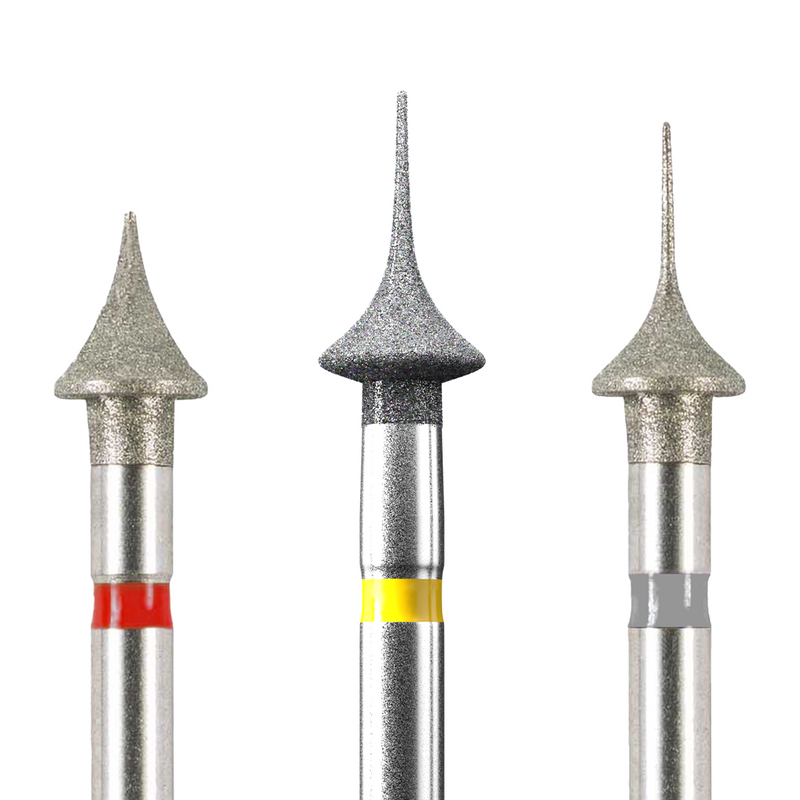
Needle burs are long and slim, made for interproximal access and fine contouring. A needle bur is thinner and longer than a flame bur, which is why it is chosen when the space is very tight. Choose between diamond, gold and carbide needle burs.


Wheel burs
Wheel burs have a flat, disc-like head used for lingual reduction and occlusal grooves. See wheel shape diamond burs and round wheel diamond burs.


Spiral cool-cut burs
Spiral cool-cut burs are special diamond burs with a left spiral groove that delivers cooling water directly to the contact point between the bur and the tooth. They allow very fast grinding with aggressive material removal while keeping an excellent surface quality.


Related Dental Rotary Instruments
These instruments work alongside burs but are classed by purpose rather than by material.
Polishers
Polishing burs are made for restoration adjustments. Dentists use them to smooth and polish materials such as zirconia, lithium disilicate, metal and composite.


Milling burs
Milling burs are used in milling units to grind and mill materials such as zirconia, e.max, PMMA, wax and PEEK when fabricating restorations. Examples: MCXL milling burs for e.max and glass ceramics, and MCX5 zirconia milling burs.


Endo files
Endo files are not burs, but they are rotary instruments used in the same handpieces. They are small, flexible rotary instruments designed to clean, shape and prepare the root canal space during endodontic treatment.


Which Bur for Which Procedure
If you start from the procedure instead of the shape, this is how the types of burs in dentistry usually line up:
| Procedure | Burs typically used | Shop |
|---|---|---|
| Cavity preparation | Round, pear (330, 245), inverted cone, fissure | Carbide burs |
| Crown and bridge preparation | Flat end and round end tapers, football, wheel | Diamond burs |
| Occlusal reduction | Football, gold football | Football burs |
| Finishing composite and restorations | Fine-grit diamonds, finishing carbides, flame | Finishing burs |
| Interproximal reduction | IPR burs, needle burs, strips | IPR burs |
| Orthodontic work | Debonding and finishing burs | Orthodontic burs |
| Surgery and bone | Round and long-shank surgical carbides | Surgical burs |
| Zirconia and ceramic work | Diamond and zirconia burs, polishers | Zirconia burs |


Ready to stock up? Dental burs kits put the common shapes in one order, or browse our best dental burs. Free shipping over $250.
Where to Buy Dental Burs
Dental burs are a basic part of any clinic's equipment, and with so many types on the market it is easy to pick the wrong one. Eagle Dental Burs supplies burs to dentists and dental labs worldwide. Our burs are made in Israel and backed by a 100% satisfaction guarantee.
Want to go deeper? Read the dental burs guide to shapes, shanks and grits, compare diamond vs carbide burs, or see how many uses a diamond bur gives.


2 comments