 EVERY ORDER SUPPORTS FAMILIES IN NEED



Updated 0 comments
Which is better for soft tissue procedures: a ceramic bur, a diode laser or a scalpel? We reviewed five clinical trials published between 2019 and 2024 that compared them. Four tested gingival depigmentation and one tested gingivectomy for gingival hyperplasia.[1][2][3][4][5] The scalpel is still described as the gold standard for depigmentation,[5] but the other two tools have been tested against it and against each other.
Ceramic bur vs laser vs scalpel: quick comparison
- Clinical results: in the depigmentation trials, scalpel, laser and ceramic bur all reduced pigmentation, and the differences in pigmentation scores between the tools were not statistically significant.[1][4][5]
- Bleeding control: the ceramic bur and the diode laser both bled significantly less than the scalpel.[4] Lasers (diode and Nd:YAG) bled less than the bur in two trials.[1][3]
- Postoperative pain: results differ between trials. The bur caused less pain than the scalpel on day 1 in a gingivectomy trial,[2] and most other comparisons showed no significant difference.
- Procedure time: the diode laser was significantly faster than both the scalpel and the bur in the one three-way trial.[4]
- Equipment and cost: the bur runs in a standard high-speed handpiece,[5] and the authors of one trial describe it as inexpensive compared with a diode laser.[1]

In this review
- What is a ceramic soft tissue bur?
- Ceramic bur, diode laser and scalpel compared
- What clinical studies say about ceramic soft tissue burs
- Ceramic bur vs laser vs scalpel: bleeding, pain, healing and speed
- Limits of the evidence
- How to use a ceramic soft tissue bur
- Ceramic bur, laser or scalpel: which should you choose?
- References
What is a ceramic soft tissue bur?
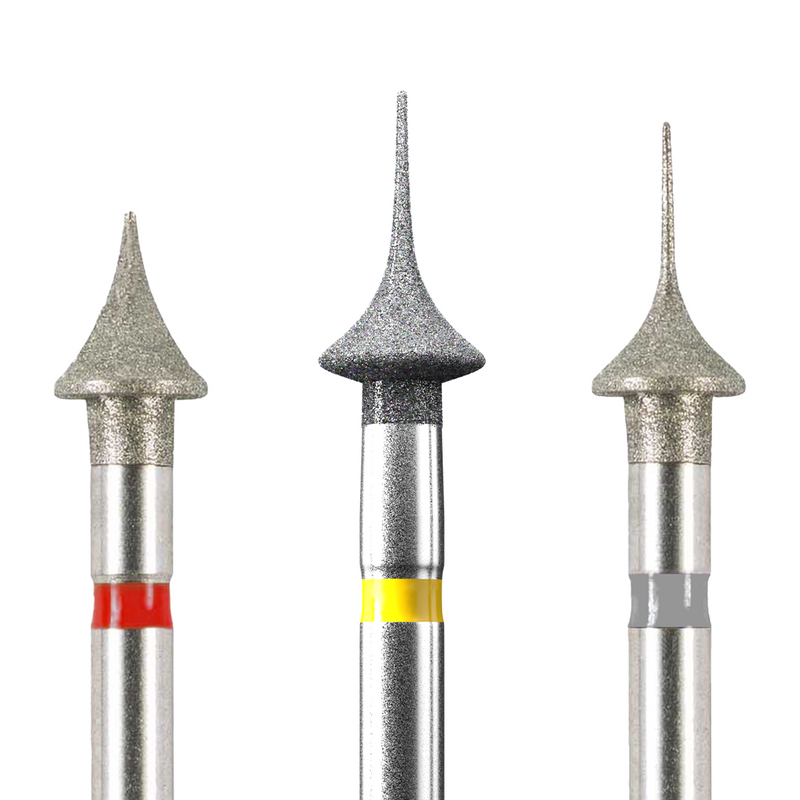
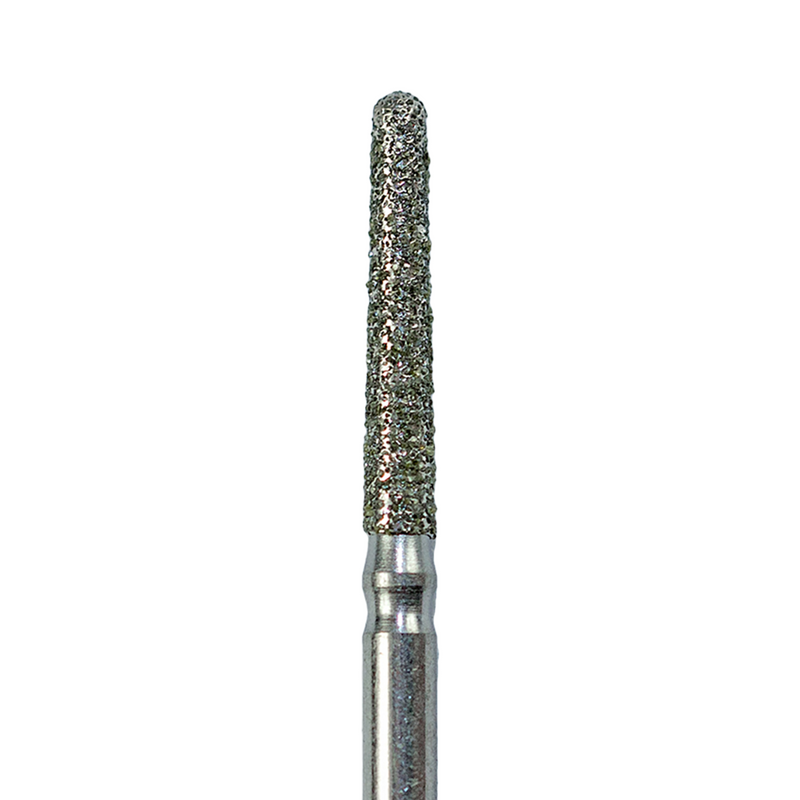
A ceramic soft tissue bur, also called a soft tissue trimmer or gingivectomy bur, is a rotary instrument designed to cut and contour gingival tissue. It is used in a high-speed handpiece without water coolant. The heat from friction ablates the tissue and at the same time coagulates the ends of the blood vessels, which helps limit bleeding.[5] The CeraTip used in one trial is a flame-shaped cylinder made of ceramic oxide. Ceramic burs were first introduced for gingivoplasty and have since been used for gingival depigmentation.[5]
Our ceramic bur soft tissue trimmer is autoclavable and reusable. It is used for gingival contouring, exposing subgingival margins, crown lengthening, frenectomy and operculectomy, and implant exposure.

Ceramic bur, diode laser and scalpel compared
| Scalpel | Diode laser | Ceramic bur | |
|---|---|---|---|
| How it removes tissue | Sharp blade; in the trials the pigmented epithelium was scraped with a no. 15 blade[5] | Laser energy through a fiber tip (980 nm diode in the three-way trial)[4] | Friction heat in a high-speed handpiece, no water coolant[5] |
| Equipment | Blade and handle | A laser unit | A standard high-speed handpiece[5] |
| Bleeding in the trials | Significantly more than bur or laser[4] | Less than scalpel;[4] diode and Nd:YAG lasers bled less than the bur in two trials[1][3] | Less than scalpel;[4] more than the laser in two trials[1][3] |
| Cost note | Described as efficient, affordable and simple[5] | Higher: needs a laser unit | Described as inexpensive and cost-effective compared with a laser;[1] reusable |
The scalpel’s drawbacks, according to the authors of one trial, are a bloody surgical field, a probable risk of infection and a high recurrence rate after depigmentation.[5]
What clinical studies say about ceramic soft tissue burs
Across the five trials, no tool was best on every measure. The table shows each trial in turn.
| Trial | Design and sample | Main findings |
|---|---|---|
| Negi et al., 2019[1] | Randomized split-mouth, 20 patients. Ceramic bur vs diode laser for depigmentation. Follow-up to 6 months. | Both reduced pigmentation, with no significant difference in the pigmentation index at 6 months. Moderate bleeding during surgery in 70% of bur sites, versus bleeding in 20% of laser sites. Complete healing at day 7: 15 of 20 bur sites vs 7 of 20 laser sites. Laser sites mostly had slight or no pain; bur sites had slight to moderate pain. |
| AlMokadem et al., 2023[2] | Randomized, 28 patients (14 per group) with inflammatory gingival hyperplasia or uneven gingival margins. Soft tissue trimmer vs scalpel gingivectomy. | Pain (VAS) was significantly lower with the trimmer on day 1 (p < 0.001). The authors conclude the trimmer is a promising, fast approach with less postoperative pain. |
| Mahayni et al., 2023[3] | Split-mouth trial, 40 patients (smokers and non-smokers). Ceramic bur vs Nd:YAG laser for depigmentation. Follow-up at 3, 6 and 9 months. | Pain and recurrence were similar. Bleeding during surgery was significantly higher with the bur, and complete healing at one week was significantly higher with the bur (p = 0.041). Smokers were more likely to have less stable results, but the difference was not significant. |
| Mikhail et al., 2023[4] | Randomized, 24 patients in three groups. Scalpel vs ceramic bur vs 980 nm diode laser for depigmentation. | The laser was significantly faster than the scalpel (p = 0.004) and the bur (p = 0.001). The bur and the laser bled significantly less than the scalpel. Pain at 12 hours was lower with the laser than the scalpel (p = 0.003), with no significant difference between laser and bur. Wound healing, epithelialization and pigmentation scores were similar. |
| Nassar et al., 2024[5] | Split-mouth randomized trial, 8 patients (16 arches). Ceramic bur (CeraTip) vs scalpel for depigmentation. Follow-up to 3 months. | Both reduced pigmentation significantly (p < 0.001). The scalpel had better initial results. The bur had less visible repigmentation, lower pain scores and greater esthetic satisfaction, but none of the differences were statistically significant. Mean operating time was 13.75 minutes with the bur and 13.88 with the scalpel. Patients preferred the bur. |
Ceramic bur vs laser vs scalpel: bleeding, pain, healing and speed
Gingival depigmentation results
All three techniques significantly reduced gingival pigmentation. None of the trials found a statistically significant difference in pigmentation scores between the techniques at follow-up.[1][4][5] The authors of the three-way trial concluded that laser and ceramic bur treatments produce equivalent aesthetic outcomes.[4]
Which technique causes less bleeding?
The ceramic bur and the diode laser both bled significantly less than the scalpel in the three-way trial.[4] Against a laser, the bur bled more: moderate bleeding was seen in 70% of bur sites, versus bleeding in 20% of laser sites, in one trial,[1] and bleeding was significantly higher with the bur than with an Nd:YAG laser in another.[3]
Postoperative pain
Pain results are mixed. The bur caused significantly less pain than the scalpel on day 1 in the gingivectomy trial.[2] In the depigmentation trials, the difference between bur and scalpel was not significant,[5] nor was the difference between bur and laser in the three-way trial or between bur and Nd:YAG laser.[3][4] The earliest trial found more pain at bur sites than at diode laser sites: laser sites mostly had slight or no pain, while bur sites had slight to moderate pain.[1]
Soft tissue healing
Healing was similar in the three-way trial.[4] Two trials that compared the bur with a laser found faster early healing at bur sites: 15 of 20 sites fully healed at day 7 with the bur vs 7 of 20 with the diode laser,[1] and complete healing at one week was significantly higher with the bur than with the Nd:YAG laser.[3]
Procedure time and repigmentation
The diode laser was the fastest tool in the three-way trial.[4] In the trial that compared the bur with the scalpel, operating times were nearly identical.[5] Repigmentation was slightly less visible with the bur than the scalpel at 3 months, but not significantly so,[5] and recurrence was similar between bur and Nd:YAG laser.[3]
Limits of the evidence
- Small trials. The samples ranged from 8 to 40 patients.
- Short follow-up. Follow-up ran from one week to nine months.
- Mostly depigmentation. Only one trial tested gingivectomy.[2]
- Different products. The trials used different ceramic burs and different lasers (diode and Nd:YAG), so results may not transfer between products.
- More research is needed. The authors of the eight-patient trial call for larger trials with longer follow-up.[5]
How to use a ceramic soft tissue bur
These are the instructions for our ceramic bur soft tissue trimmer. Always check the instructions supplied with your burs.
- Position the bur at a 45° angle to the targeted tissue.
- Apply steady, even pressure across the area for controlled, uniform tissue removal.
- For extra coagulation or precise contouring, apply the bur to specific spots with gentle pressure.
- Avoid over-reduction. Trim in small increments.
- Avoid contact with hard surfaces such as teeth, because rapid impact may damage or break the bur.

In the trials that reported it, the bur was used in a high-speed handpiece without water coolant.[3][5] In one trial, the bur and the gingiva were cleaned of debris during the procedure with sterile gauze soaked in saline, and a periodontal pack was placed for one week after surgery in both groups.[5] Check the RPM range on your bur’s packaging. The CeraTip in one trial was run at 300,000–450,000 RPM without cooling, as its manufacturer recommends.[3]
In the shop: ceramic bur soft tissue trimmer · periodontic crown lengthening kit · dental surgical burs
Ceramic bur, laser or scalpel: which should you choose?
The trials found comparable pigmentation results with all three tools, so the choice comes down to the procedure, the equipment you own, how much bleeding you can accept and how patients experience the procedure.
- Ceramic soft tissue bur: a practical option for controlled gingival tissue removal without investing in laser equipment. In the reviewed trials it gave pigmentation results comparable to the other tools[1][4][5] and less bleeding than a scalpel in the three-way trial,[4] but more bleeding than lasers in two trials.[1][3] The authors describe it as effective, easy to perform and cost-effective, and patients preferred it in one trial.[1][5]
- Diode laser: strong bleeding control, since lasers bled less than the bur in two trials,[1][3] and the fastest tool in the three-way trial.[4] It requires dedicated laser equipment.
- Scalpel: the conventional reference technique for depigmentation, valued for efficiency, affordability and simplicity.[5] It caused more bleeding than both the bur and the diode laser in the three-way trial.[4]
Conclusion
Across five clinical trials, no single tool was best on every measure. All three produced effective gingival depigmentation. The ceramic bur bled less than the scalpel in the three-way trial, lasers bled less than the bur in two trials, and the diode laser was the fastest tool in the one trial that timed all three.
For dentists who do not use a laser, the ceramic soft tissue bur offers a practical way to perform gingival depigmentation and gingivectomy with a standard high-speed handpiece. However, the trials were small, and larger studies with longer follow-up are still needed.
Explore Eagle Dental ceramic soft tissue burs
Designed for gingival contouring, gingivectomy and soft tissue trimming. Reusable and autoclavable. Free shipping over $250.
Need help choosing the right ceramic bur? Contact the Eagle Dental team.
References
- Negi R, Gupta R, Dahiya P, Kumar M, Bansal V, Samlok JK. Ceramic soft tissue trimming bur: a new tool for gingival depigmentation. J Oral Biol Craniofac Res. 2019;9(1):14–18. doi:10.1016/j.jobcr.2018.07.002. PMID 30197858. DOI · Full text (PMC)
- AlMokadem MMS, Abdelrahman AR, Nasr SS, Elkhouly S. Clinical efficacy of soft tissue trimmer versus conventional surgical excision of gingival hyperplasia on postoperative pain: a randomized clinical trial. Adv Dent J. 2023;5(1):119–143. doi:10.21608/ADJC.2023.188180.1246. DOI
- Mahayni M, Kujan O, Hamadah O. Aesthetic gingival melanin pigmentation treatment in smokers and non-smokers: a comparison study using Nd:YAG laser and ceramic bur. J Pers Med. 2023;13(7):1034. doi:10.3390/jpm13071034. DOI · Full text (PMC)
- Mikhail FF, El Menoufy H, El Kilani NS. Assessment of clinical outcomes and patient response to gingival depigmentation using a scalpel, ceramic bur, and diode laser 980 nm. Clin Oral Investig. 2023;27(11):6939–6950. doi:10.1007/s00784-023-05310-w. DOI · Full text (PMC)
- Nassar SK, Abuel-Ela HA, Fouad YA. Ceramic soft tissue trimming bur gingival depigmentation: clinical performance and patient experience. A split mouth randomized controlled trial. BMC Oral Health. 2024;24:602. doi:10.1186/s12903-024-04345-z. PMID 38783312. DOI · Full text (PMC)


0 comments