EVERY ORDER SUPPORTS FAMILIES IN NEED



Flame Carbide Burs
Related products
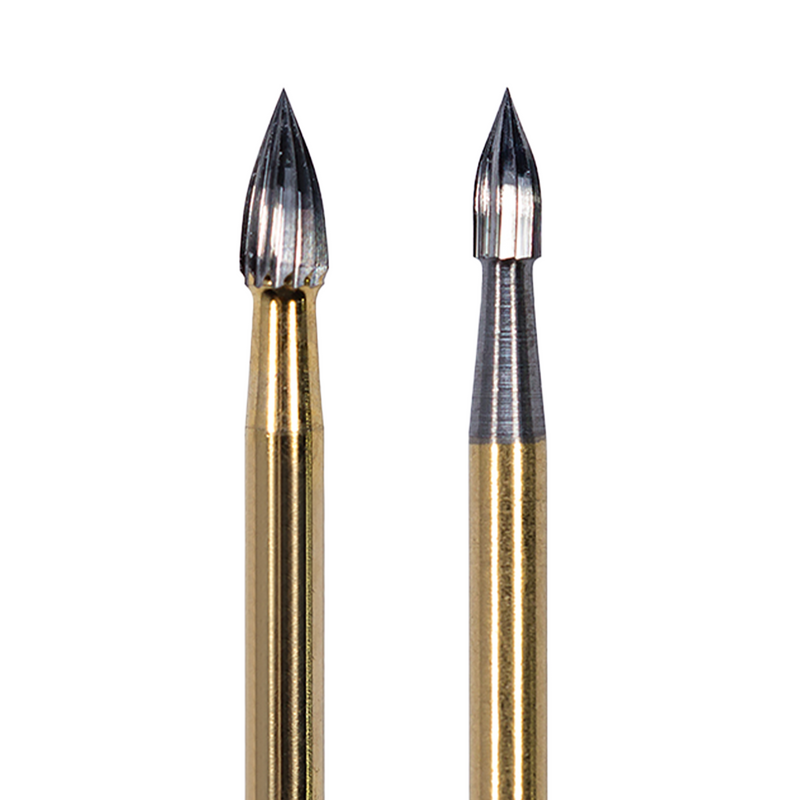
Flame Carbide Finishing Burs 7104 and 7106: 12 Blades, FG Shank
Eagle flame carbide burs 7104 and 7106 are 12-blade finishing burs for trimming and finishing composite restorations. Because they are used mainly for finishing, they are also known as flame shaped finishing burs; the name comes from the pointed, flame-like head. They are made of one-piece tungsten carbide, and each pack contains 5 burs.
What Is a Carbide Flame Bur Used For?
- Trimming excess composite after curing
- Contouring and finishing restorations, including occlusal anatomy
- Finishing near the gingival margin and on interproximal surfaces
- Removing excess cement or residual adhesive
The pointed, tapering head reaches margins, grooves and contours that a rounder bur cannot.
Code Guide
- 7104 – 12-blade flame finishing bur, FG shank
- 7106 – 12-blade flame finishing bur, FG shank
The 7104 and 7106 differ mainly in head size and length. Compare the product photos and pick the one that fits the restoration size and access.
Where a Flame Finishing Bur Works Best
- Occlusal anatomy: the tip defines fissures and secondary grooves on posterior composites.
- Embrasures and line angles: the taper slips into facial and lingual embrasures.
- Gingival margins: the point follows the cervical contour on Class V restorations.
- Lingual concavities: the narrow head shapes lingual anatomy on anterior teeth.
Flame Finishing Bur Compared With Other Shapes
- Flame: pointed tip - anatomy, grooves, embrasures and lingual concavities
- Bullet: rounded tip - broad convex surfaces
- Round end taper: rounded tip with tapered sides - margins and chamfers
- Tapered: flat sides - straight axial walls
Because the flame shape covers the detailed areas other shapes can't reach, it is a common second bur in a composite finishing sequence, after the bulk of the excess has been trimmed.
How to Use a Carbide Flame Bur
- Cure fully before trimming.
- Remove excess at the margins with the side of the flame, keeping the bur moving.
- Carve anatomy with the tip in short, light strokes - don't plunge it into the composite.
- Check occlusion and adjust high spots.
- Refine with a 30-blade bur or a fine diamond, then polish.
Run the FG bur in a high-speed handpiece at the speed recommended by the handpiece and bur manufacturer, with light pressure and water spray to control heat.
Flame vs Bullet Carbide Burs
A flame bur ends in a point and tapers along its length, which suits fine margins and grooves. A bullet bur has a rounded tip and straighter sides, which suits broader surfaces. If you want the rounded version, see our bullet carbide burs.
Carbide Flame Bur vs Diamond Flame Bur
A carbide flame bur cuts with blades and is used mainly to finish composite. A diamond flame bur abrades and is used mostly for tooth preparation, margins and ceramic adjustments, with fine grits for finishing.
12-Blade vs 30-Blade Finishing Burs
More blades remove less material per revolution and leave a smoother surface. A 12-blade flame bur is used for trimming and initial contouring; a 30-blade bur is used for final finishing before polishing.
Cleaning, Sterilization and Bur Life
Before each use, pre-soak in a disinfectant suitable for carbide burs, clean ultrasonically in a bur holder, rinse, dry, pouch and autoclave following your clinic's protocol. Avoid cold sterilizing solutions and hydrogen peroxide, which can degrade tungsten carbide.
Tips for Longer Bur Life
- The fine tip is the most delicate part - avoid levering or heavy pressure on it.
- Seat the shank fully in the chuck to prevent wobble.
- Replace the bur when the tip chips or it stops cutting cleanly.
Specifications
- Shape: flame
- Blades: 12
- Shank: FG friction grip for high-speed handpieces
- Material: one-piece tungsten carbide
- Codes: 7104, 7106
- Pack size: 5 burs per pack
- Origin: made in Israel
For more shapes, browse our full range of carbide burs.
Ready to Subscribe?