EVERY ORDER SUPPORTS FAMILIES IN NEED



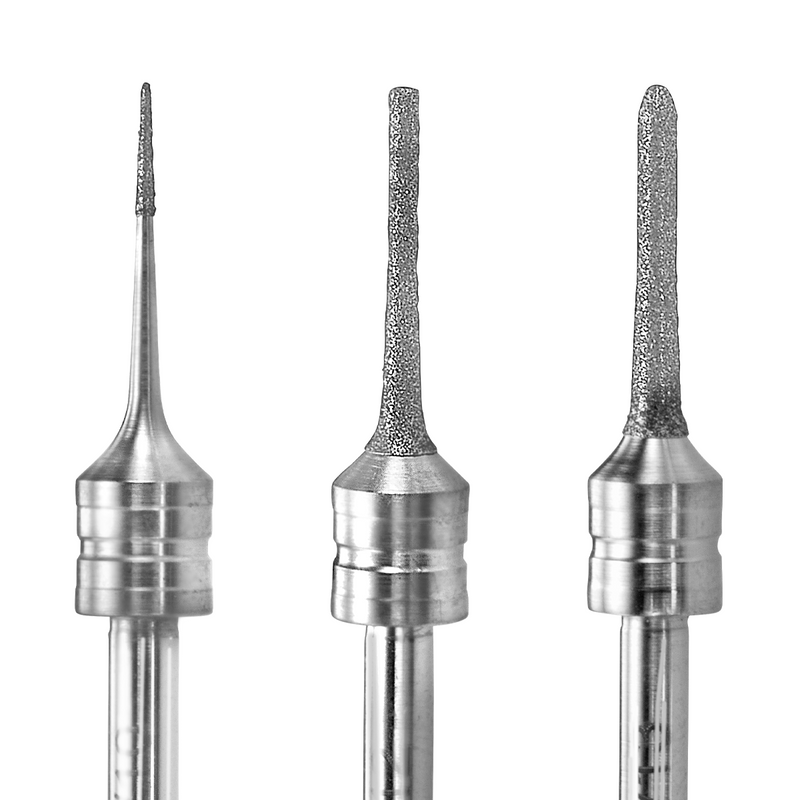
Amann Girrbach Roto diamond milling burs
Related products
Diamond Milling Burs for E.max and Glass Ceramics on Ceramill Mills
Eagle Roto diamond milling burs are grinding burs for lithium disilicate (E.max) and other glass ceramic blocks, compatible with Amann Girrbach Ceramill milling units that grind glass ceramics. They come in four diameters (0.4, 1.0, 1.4 and 1.8 mm), with 5 burs of the same size in each pack.
Why Diamond Grinding for Glass Ceramics
Lithium disilicate and glass ceramics are hard and brittle. They are ground rather than cut, so the tool needs a diamond grinding surface instead of a sharp carbide edge. Diamond removes this material in a controlled way, which helps you get smooth surfaces and clean, thin margins on crowns, inlays, onlays and veneers. A carbide bur used on glass ceramics wears out fast and leaves poor surfaces.
Sizes and What Each One Does
| Size | Main job | Typical areas |
|---|---|---|
| 0.4 mm | Finest detail | Fissures, margins, occlusal anatomy |
| 1.0 mm | Detail finishing | Cusps, contours, smaller inner areas |
| 1.4 mm | General finishing | Outer and inner surfaces |
| 1.8 mm | Roughing | Fast removal of bulk material |
How to Read the Sizes
The size is the bur diameter in millimeters. Your Ceramill software links each diameter to a tool position in the grinding strategy, so always replace a worn bur with one of the same diameter. Check the tool list in your software before you order to see which positions are worn, then choose those sizes. Each pack holds 5 burs of the size you select.
Which Ceramill-Compatible Bur for Which Material
| Material | Bur type | Milling mode |
|---|---|---|
| E.max and glass ceramics | Diamond grinding burs (this page) | Wet, with coolant |
| Pre-sintered zirconia | CVD diamond-coated burs | Typically dry |
| PMMA, wax, PEEK | Uncoated burs | Per your software strategy |
Why Wet Grinding Matters
E.max and other glass ceramics are ground wet. Coolant carries away heat and ceramic debris, which protects both the diamond surface and the restoration. Grinding with too little coolant overheats the bur and can crack thin areas, so keep the coolant tank filled, clean and mixed as your machine manual specifies.
When to Replace a Diamond Milling Bur
Bur life depends on the block type, restoration size, grinding strategy and coolant condition, so there is no fixed number of units. Replace the bur when you see:
- Rougher surfaces, or more polishing time needed after grinding
- Chipping at thin margins on crowns, veneers or inlays
- Grinding times longer than your software estimates
- A worn or smooth diamond surface at the bur tip
- A tool-life warning in your milling software
Tips for Longer Bur Life and Better Surfaces
- Use these burs only on glass ceramics and lithium disilicate.
- Change the coolant on schedule and rinse ceramic sludge from tool holders and the grinding chamber.
- Insert each bur straight, register it in your software and reset its usage time.
- Store spare burs in their packaging so the diamond surface is not damaged.
- Do not reuse a bur that was dropped or shows a chipped tip.
- If margins start to chip, check the coolant level and condition before replacing the bur.
Common Problems and Bur-Related Causes
- Chipped margins: a worn 0.4 mm or 1.0 mm detail bur, or low coolant.
- Cracks or burn marks: not enough coolant, or a dull bur generating heat.
- Broken bur: a worn tool kept in use, a bur not seated correctly or debris in the holder.
- Rough or stepped surfaces: a dull bur or the wrong diameter in a tool position.
Compatible, Not Original
These are Eagle-brand diamond burs made to be compatible with Amann Girrbach Ceramill milling units. They are not original Amann Girrbach tools. For zirconia on the same mill, use our CVD diamond zirconia milling burs, or browse all dental CAD/CAM milling burs for other machines.
Ready to Subscribe?